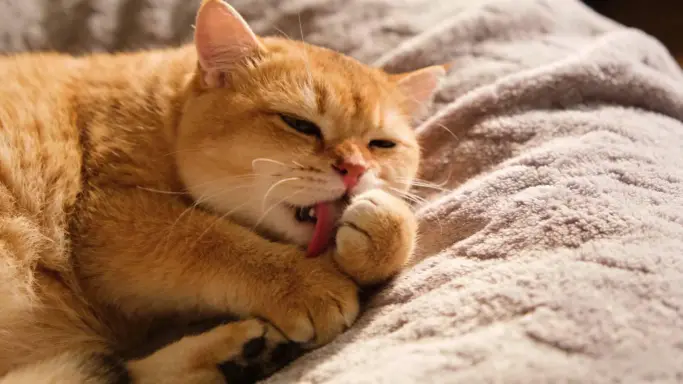

Many cat owners have encountered such a scene: their adult cat suddenly curls up on the sofa, repeatedly sucking and kneading a soft blanket, much like a newborn kitten nursing. Many owners wonder why this “kitten-exclusive” behavior appears in adult cats—could it be that the cat is sick? In fact, adult cats sucking blankets is a common and mostly harmless behavior, which hides the cat’s emotional needs and physiological memories. Understanding this behavior allows us to better understand our feline friends and protect their physical and mental health.
Similar to human comfort habits, a cat’s sucking behavior is also a way of self-regulation. It may be a continuation of innate instincts or a “barometer” of emotions. In most cases, this behavior does not require intervention, but if abnormal signs appear, we need to pay more attention and seek veterinary help if necessary.
Core Reasons Why Adult Cats Suck Blankets (Not Repeating the Original Content)
1. Continuation of Instinct: An Ingrained “Comfort Memory”
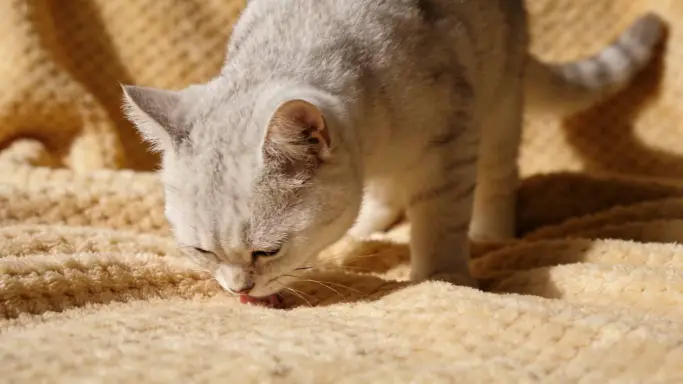
Sucking is an innate survival instinct for cats. Newborn kittens obtain nutrition by sucking their mother’s milk, and at the same time, the sucking motion makes them feel warm, safe and comfortable—this feeling is deeply etched in their memories. Unlike humans, some cats’ this instinct does not completely fade as they grow into adults. When they feel relaxed, sleepy, or in need of comfort, they will look for soft items with a texture similar to their mother’s fur—such as blankets and plush fabrics—and recreate the sense of security from their childhood through sucking, just like humans still gain comfort by holding dolls or listening to children’s songs when they grow up.
2. Emotional Release: A “Secret Weapon” to Relieve Stress and Anxiety
Cats may seem cold, but they are actually sensitive and easily stressed by changes in the external environment. However, unlike dogs that express anxiety through barking or pacing, cats release emotions through subtle behaviors, and sucking blankets is one of them. When there is a new pet at home, moving, renovation, changes in the owner’s schedule, or strange smells in the environment, cats will release endorphins by sucking blankets to relieve inner restlessness and calm themselves down quickly. This behavior is equivalent to a cat’s “stress relief method” and helps them adapt to environmental changes.
3. Breed Characteristics: Some Breeds Are More Prone to Retaining Juvenile Behaviors
A cat’s sucking behavior is also closely related to its breed. Among them, Oriental breeds such as Siamese cats, Balinese cats, and Tonkinese cats are more likely to retain kittenhood behaviors, including sucking and kneading fabrics, due to genetic characteristics. These cats have more obvious “neoteny” traits—even as adults, they frequently gain comfort by sucking blankets. This is their breed nature, not an abnormal performance.
4. Early Life Experience: “Compensatory Behavior” from Premature Weaning
If a cat is separated from its mother and weaned too early (the ideal weaning period is 8-12 weeks), its oral stage needs will not be fully met. When it grows into an adult, it will make up for the lack of childhood by sucking blankets, plush toys and other items. Essentially, this behavior is a kind of “compensatory comfort”, just like babies may seek comfort by biting their fingers or holding dolls after being weaned too early.
5. Expression of Affection: Trust and Dependence on the Owner
Many cats only suck blankets when they are around their owners, which is actually their way of expressing love and trust. In a cat’s eyes, the owner is a “substitute mother” who can give them a sense of security. When they snuggle up to their owner and suck blankets, it is equivalent to sending a signal of “I feel safe here and I trust you”—a reflection of the close relationship between the cat and its owner.
Abnormal Signals to Watch Out For
Although adult cats sucking blankets is mostly harmless, you need to be alert and consult a veterinarian in a timely manner if the following situations occur to avoid affecting the cat’s health:
- Sudden changes in behavior: If the cat has never had a sucking behavior before but suddenly starts sucking blankets frequently, especially cats over 5 years old, it may indicate potential health problems;
- Accompanied by abnormal symptoms: Vomiting, weight loss, listlessness, excessive drooling, etc., during sucking may be related to toothache, gastrointestinal problems or other diseases;
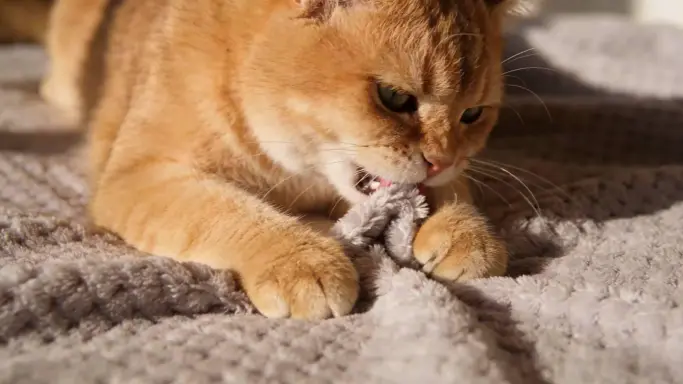
- Destructive sucking: Not only sucking, but also biting and swallowing fabrics, which may lead to intestinal obstruction and even endanger life;
- Excessively persistent behavior: The sucking behavior continues throughout the day, replacing normal eating and playing, and even affecting the cat’s normal life.
Practical Methods for Gentle Guidance
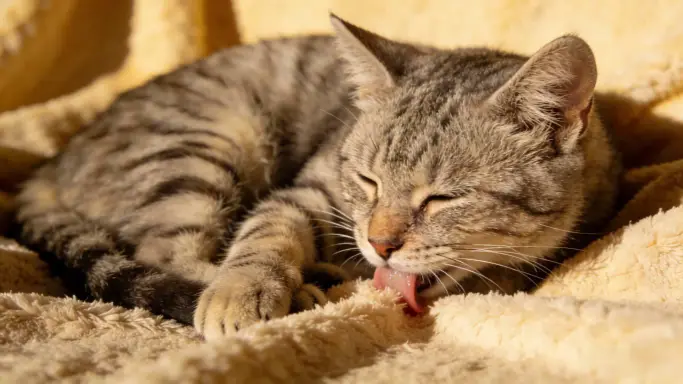
If the cat’s sucking behavior is not abnormal but affects the owner’s life (such as sucking precious fabrics), there is no need to stop it forcibly. You can gently guide it through the following methods, which not only do not go against the cat’s nature but also reduce troubles:
- Prepare alternative items: Specifically prepare 1-2 soft blankets or plush toys as the cat’s “exclusive sucking items”. You can apply a small amount of catnip on them to enhance their attractiveness. When the cat sucks other items, gently guide it to switch to the alternative;
- Increase interaction and energy consumption: Add 10-15 minutes of interactive games every day, using toys such as cat wands and laser pointers to consume the cat’s energy. A tired cat will reduce sucking behavior and also relieve stress;
- Optimize the living environment: Create a safe and comfortable living space for the cat, provide scratching posts, cat trees, hiding boxes, etc., to reduce stressors in the environment and make the cat feel more secure;
- Try pheromone therapy: Use a cat-specific pheromone diffuser (such as Feliway) to simulate the cat’s natural calming pheromones, help the cat relieve anxiety, and reduce sucking behavior caused by stress;
- Adjust the feeding method: Divide the daily feeding amount into 3-4 portions to avoid the cat sucking due to long intervals between meals and boredom. At the same time, use puzzle feeders to stimulate the cat’s hunting instinct and divert its attention.
Deep Psychology of Cats’ Comfort Behaviors
Essentially, a cat’s sucking behavior is a “comfort behavior” with deep psychological logic. When a cat’s brain performs behaviors such as sucking and kneading, it releases oxytocin—the “love hormone”—which makes the cat feel relaxed and happy, just like the feeling when humans hug and touch.
At the same time, a cat’s sucking behavior is closely related to memory. Through the texture and smell of the blanket, they will associate it with the scene of snuggling up to their mother when they were young, and this associative memory can bring them a strong sense of security. In addition, the “neoteny” trait of cats allows some cats to retain kitten behavior patterns even as adults. This trait not only makes them more lovely but also makes them more dependent on the owner’s company and comfort.
It is worth noting that the way the owner interacts with the cat also affects this behavior. If the owner comforts and strokes the cat in a gentle tone when it is sucking or kneading, it will strengthen this behavior, making the cat think that “this behavior can get the owner’s attention and love”, thus appearing more frequently.
Frequently Asked Questions (FAQs)
Q: Is it harmful for adult cats to suck blankets? A: Usually harmless, it is a comfort behavior of cats; if there is fabric biting and swallowing or accompanied by abnormal symptoms, it needs attention.
Q: Why does my cat only suck blankets when it’s around me? A: It is an expression of trust and affection. The owner’s company makes the cat feel safe, similar to the feeling of snuggling up to its mother when it was young.
Q: Which cat breeds are more likely to suck blankets? A: Oriental breeds such as Siamese cats and Balinese cats are more likely to retain juvenile sucking behavior due to genetic characteristics.
Q: How to stop my cat from sucking my favorite fabrics? A: Prepare alternative sucking items to guide the cat to switch, and increase interaction and optimize the environment—there is no need to stop it forcibly.
Q: Do I need to worry if my old cat suddenly starts sucking blankets? A: Yes, it may indicate health problems such as toothache and cognitive decline. It is recommended to consult a veterinarian in a timely manner.