
Many cat owners have a fixed perception: cats are cold and stubborn, and unlike dogs, they don’t follow commands and can’t be trained at all. But in fact, cats are not “untrainable”—their training logic is completely different from that of dogs. Cats focus more on “active participation” and “positive feedback” and dislike coercion and punishment. Clicker training is a training method that fits a cat’s nature perfectly. It requires no scolding or coercion; with simple signals and rewards, it can make cats cooperate actively and even learn various cool little skills. Whether it’s an active kitten or a calm adult cat, they can gain joy and growth through clicker training, and you can also understand your cat’s emotions and build a deeper intimate relationship during the training process.
Getting to Know Clicker Training: A “Positive Signal” Cats Can Understand
The core logic of clicker training comes from “operant conditioning”. Simply put, it uses a combination of “signal + reward” to make cats associate a specific sound with “correct behavior” and “receiving a reward”, thereby actively repeating the correct behavior. The “signal” here is the “click” sound made by the clicker. It is like an “instant affirmation” switch that can accurately capture the moment a cat does the right action, allowing the cat to clearly know “what it did right”.
Different from traditional training, the key to clicker training is “instant feedback”—the moment the cat performs the target behavior, press the clicker immediately, and then give a reward. The time difference should not exceed 1 second, otherwise the cat will not be able to associate the “click” sound with the “correct behavior”. Many people mistakenly think that the clicker is a “command tool”, but in fact, it is more like a “communication tool”, an exclusive “positive code” between you and your cat, allowing the cat to understand your intentions in a relaxed atmosphere.
It is worth noting that clicker training is not exclusive to cats; dogs also often use this method. However, cats are extremely sensitive to “instant rewards”, and their cooperation is even no less than that of dogs. As long as the method is proper, you can see results quickly.
The Core Value of Clicker Training: More Than Just “Tricks”
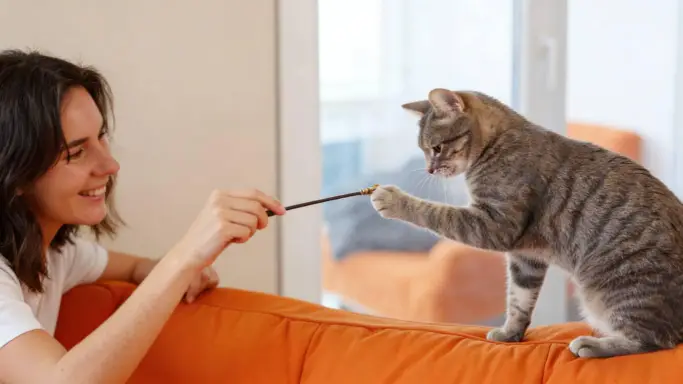
Many people carry out clicker training just to let their cats learn good-looking tricks like “high five” and “spin”, but in fact, the value of clicker training is far more than that. It can improve the cat’s quality of life in many aspects and make cat ownership easier.
1. Deepen the Human-Cat Bond and Narrow the Intimate Distance
The essence of clicker training is “positive interaction”, with no punishment throughout, only affirmation and rewards. When the cat finds that as long as it cooperates with you, it can get its favorite snacks and your attention, it will gradually let down its guard and trust you more. During the training process, the eye contact and physical interaction between you and your cat will become a bond to enhance your relationship, turning the cat from a “cold companion” into an “actively clingy” close friend.
2. Enrich the Cat’s Life and Reduce Mischievous Behaviors
Cats are born “curious babies”. Once they feel bored, they will engage in mischievous behaviors such as knocking over vases, scratching furniture, and running around at night. Clicker training is equivalent to providing “mental exercise” for cats. By learning new skills, it stimulates the cat’s brain activity, consumes its energy, and allows the cat to gain a sense of accomplishment in “learning”, thereby reducing destructive behaviors caused by boredom.
3. Improve the Cat’s Adaptability and Deal with Daily Problems
In daily life, many cat-raising scenarios are “challenges” for cats—administering medicine, cutting nails, going to the pet hospital, etc., often make owners feel troubled. Through clicker training, you can teach cats basic commands such as “sit”, “come”, and “quiet”. In these scenarios, you only need to issue a command to make the cat cooperate, which greatly reduces the difficulty of operation and also reduces the cat’s stress response.
4. Help Shy Cats Build Confidence
For rescued cats, shy kittens, or introverted cats, clicker training is an excellent way to build confidence. Every time they successfully complete a command and receive a reward, the cat will feel “I can do it”, gradually get rid of shyness, become more cheerful and confident, and better adapt to family life.
Pre-Training Preparation: Get All Tools at Low Cost
Clicker training does not require high-tech equipment. It is low-cost and easy to prepare, even for beginners. You only need to prepare 3 core things, and you can even use existing items at home as substitutes.
1. Clicker (Core Tool)
The clicker is the core of training. Common clickers on the market are similar to keychains with buttons, low in price (less than $5 online), and easy to operate—just press gently to make a clear “click” sound. If you don’t have a ready-made clicker, you can also use items at home as substitutes—such as pressing a pen nib to make a click sound, or flicking your tongue to make a crisp sound. As long as the sound is clear and fixed, it can be used as a “substitute clicker”.
2. High-Value Treats (Core Reward)
Rewards are the “motivation source” of clicker training. You must choose “high-value treats” that your cat particularly likes to stimulate its willingness to cooperate. It is recommended to choose treats with strong aroma and soft taste, such as cooked chicken cubes, fish fillets, freeze-dried food, or commercially available special cat treats. Avoid using the cat’s daily cat food as a reward, otherwise it will not have an “incentive effect”. In addition, cut the treats into small pieces and give only a little each time—this not only prevents the cat from being picky or overweight, but also keeps the cat looking forward to the reward.
3. Patience and Concentration (Key Premise)
Cats’ learning speeds vary from one to another. Some cats can master basic commands in 5 minutes, while others may take days or even weeks—this is normal. During training, you must be patient. Do not scold, coerce, or give up just because the cat can’t learn. At the same time, stay focused during each training session, do not get distracted by looking at your phone or watching TV, and ensure that you can accurately capture the cat’s correct behavior, press the clicker in time, and give rewards.
Step-by-Step Training: A Complete Process from Basics to Advanced Skills
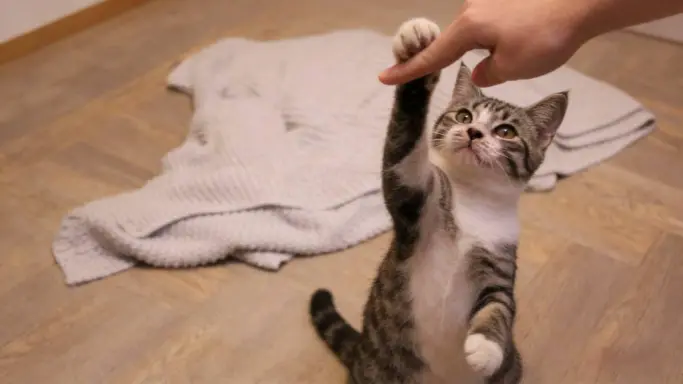
Clicker training cannot be rushed. It must follow the principle of “from easy to difficult, step by step”. First, let the cat understand the meaning of the clicker, then learn basic commands, and finally unlock advanced skills. Each step must be solid to ensure that the cat truly masters them.
Step 1: Clicker “Charging”—Let the Cat Understand “Click = Reward”
Before teaching the cat any skills, you must first complete “clicker charging”, which means letting the cat understand: as long as it hears the “click” sound, there will be a snack reward. This is the foundation of the entire training; only after charging is completed can the subsequent training proceed smoothly.
Specific operation: Find a quiet, distraction-free room, let the cat relax, and hold the clicker and treats in your hand. Press the clicker gently to make a “click” sound, and feed the cat a small piece of treat within 1 second after the sound. Repeat this action 5-10 times per training session, 2-3 times a day, for 2-3 days. When you press the clicker and the cat takes the initiative to look at you, approach you, and look forward with anticipation, it means the clicker is fully charged.
Tip: During charging, do not issue any additional commands or deliberately guide the cat to do actions. Just “press the clicker → give a treat” to ensure that the cat directly associates the “click” sound with the “treat”.
Step 2: Basic Command—”Look at Me” to Build an Interaction Foundation
“Look at Me” is the most basic and core command. Learning this command can make the cat more focused on you, laying a foundation for learning other skills later. Beginners can start with this command.
Specific operation: Hold a treat, place it near your cheek, keep still, and wait for the cat to look at you actively. The moment the cat makes eye contact with you, press the clicker immediately and give a treat reward. Repeat this action for 5-10 minutes per training session, 1-2 times a day.
When the cat can actively look at you proficiently, you can add a verbal command—while waiting for the cat to look at you, say “Look at Me” softly, and after it makes eye contact, press the clicker and give a reward. Gradually, the cat will associate the verbal command “Look at Me” with the “eye contact action”, and even without treat guidance, it will take the initiative to look at you when you issue the command.
Step 3: Target Training—The “Key” to Unlocking Complex Skills
Target training is a key step in clicker training. Simply put, it is training the cat to touch a specific object (such as a spoon, your finger, or a small toy) with its nose or paw. In this way, you can guide the cat to perform more complex actions such as “sit”, “spin”, and “high five”.
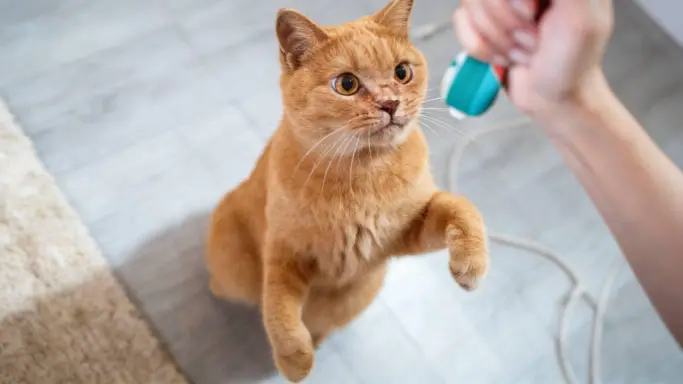
Specific operation: Choose a small, safe object as the “target” (such as a finger or a small spoon), place the target 3-5 inches away from the cat’s cheek, and wait for the cat to react. The moment the cat smells, touches the target with its nose, or touches it with its paw, press the clicker immediately and give a treat reward.
After repeating several times, slowly move the target farther, higher, or change its position to guide the cat to follow the target. When the cat can follow the target smoothly, you can use the target to guide it to perform specific actions—for example, place the target above the cat’s head to guide it to look up and sit down; circle the target around the cat to guide it to spin along.
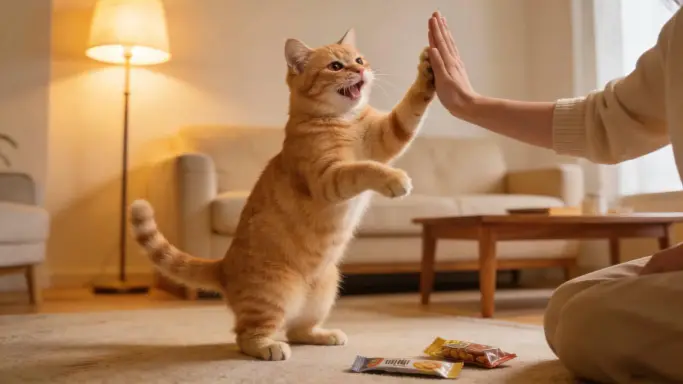
Step 4: Entry-Level Skill—”High Five” to Unlock the First “Talent”
“High Five” is a skill that many cat owners want their cats to learn. It is moderately difficult, and you will gain a great sense of accomplishment after learning it. Moreover, it can be quickly mastered through target training.
Specific operation: First, hold a treat in your hand, keep your fingers together, place your palm near the cat’s paw, and shake gently to attract the cat’s attention. Most cats will pat your palm with their paw out of curiosity, trying to get the treat inside. The moment the cat lifts its paw and touches your palm, press the clicker immediately and give a treat reward.
After repeating several times, gradually raise the height of your palm so that the cat needs to lift its paw to touch your palm. When the cat can proficiently lift its paw to touch your palm, add the verbal command “High Five”. After issuing the command, wait for the cat to perform the action, and after the action is completed, press the clicker, give a reward, and praise the cat softly at the same time.
Tip: Different cats have different learning speeds. Some cats can learn it in a few days, while others may take weeks. Do not rush. Control each training session to within 10 minutes to avoid the cat feeling resistant.
Unlocking Advanced Skills: Create Your Own “Talented Cat”
When the cat proficiently masters basic skills such as “Look at Me” and “High Five”, you can use your creativity to unlock more advanced skills and make the cat a “talent”. The following advanced skills are simple to operate and suitable for beginners to try.
1. Exclusive Spot: Learn to “Return to Its Own Nest”
Training the cat to return to its exclusive spot (such as a cat bed or mat) can not only cultivate good habits in the cat, but also make the cat quiet down quickly when guests come or the cat is naughty.
Operation method: Place the cat’s bed or mat in a fixed position, hold a treat, and guide the cat to walk to the mat. When the cat walks to the mat, sits down, or lies down, press the clicker immediately, give a treat reward, and say “Go Home” softly. Repeat the training, gradually reduce the treat guidance, until the cat can take the initiative to walk to its exclusive spot when you issue the “Go Home” command.
2. Spin: Unlock the “Spin Talent”
Spinning is a fun and simple advanced skill that can be easily taught using target training, suitable for active cats.
Operation method: Hold a target (such as a finger or a treat), circle it in front of the cat, and guide the cat to follow the target to spin. When the cat completes a full circle, press the clicker immediately, give a treat reward, and add the verbal command “Spin”. Repeat the training, gradually speed up the spinning speed, reduce the target guidance, and let the cat complete the spinning action according to the command.
3. Fetch Game: Cultivate the Cat’s “Interaction Awareness”
Many people think that only dogs can play fetch, but in fact, cats can also learn the fetch game. This not only increases interaction fun, but also consumes the cat’s energy.
Operation method: Choose a small toy that the cat likes (such as a small ball or a plush toy), and throw it 1-2 meters away. If the cat takes the initiative to run to pick up the toy or approach it, press the clicker immediately and give a treat reward. Gradually guide the cat to bring the toy back to you, and when the cat brings the toy back to you, give a more generous reward (such as more treats or gentle petting).
Tip: Not all cats like the fetch game. If the cat shows resistance or disinterest, do not force it—choose a skill that is more suitable for it.
Frequently Asked Questions (FAQ)
Many beginners will encounter various problems when carrying out clicker training. The following are the 6 most common questions and solutions to help you avoid misunderstandings and complete the training smoothly.
Q1: What should I do if my cat ignores me completely during training?
A: The key is to shorten the training time (5-10 minutes per session, 1-2 times a day) and choose a quiet, distraction-free environment; use high-value treats to attract the cat’s attention, and start training after it is focused.
Q2: My cat is afraid of the clicker sound and runs away when it hears it. How to handle this?
A: Use a soft substitute clicker (pen click, tongue flick) or lower the clicker volume. In the early stage, press the clicker gently and give a reward, then gradually increase the volume to let the cat adapt—do not force it.
Q3: My cat is only interested in treats and will not cooperate without them. How to improve this?
A: Gradually reduce the frequency of treat rewards, add non-treat rewards such as petting and praise, let the cat understand that cooperation can bring various pleasures, and finally gradually cancel the treat rewards.
Q4: I have been training for a long time, but my cat still can’t learn a skill. Should I give up?
A: Do not give up! You can reduce the training difficulty, extend the training cycle, and insist on short training sessions every day; pause when the cat is resistant, and continue when it is in a good mood to avoid causing disgust.
Q5: Can adult cats be clicker trained, or only kittens?
A: Adult cats can be clicker trained completely! Their learning ability is no less than that of kittens, but they need more time to adapt; even senior cats can exercise their brains through training—the key is patience and suitable treats.
Q6: Do I need to punish my cat when it occasionally does the wrong action during training?
A: Absolutely not! Ignore the wrong behavior and wait for the cat to do the right action before rewarding it; if it makes mistakes frequently, reduce the difficulty and guide it again to avoid damaging the human-cat trust.