

Welcoming a fluffy puppy into your home is undoubtedly one of the warmest surprises in life. But behind this surprise, new owners often feel at a loss: indoor accidents, chewing furniture, ignoring commands, jumping on people… Do these problems make you feel helpless and anxious?
In fact, puppy training is not as difficult as you think. The core is not “disciplining”, but “guiding”. As a beginner, you don’t need to master complex training skills. You just need to grasp your puppy’s growth rules, and with patience and scientific methods, you can help it gradually develop good habits and become a gentle and obedient family companion. This guide is specially designed for beginners with zero experience, avoiding professional jargon and providing easy-to-understand practical tips to help you start your puppy training journey smoothly.
Core Training Principles: 3 Key Points Every New Owner Must Remember
Before starting any training, mastering these 3 core principles can double your training efficiency, strengthen your bond with your puppy, and avoid the mistake of “straining your relationship through training”.
First, Start Early and Grasp the Critical Period. The best time to start puppy training is 8-12 weeks old. At this stage, puppies are curious, have strong learning abilities, haven’t developed bad habits yet, and are most receptive to their owner’s commands. If you miss this period, you can still train your puppy, but you will need more time to correct existing bad habits.
Second, Positive Reinforcement, No Punishment. Puppies are not yet mentally mature. Beating, scolding, or physical punishment will not only make them afraid of you but also may lead to low self-esteem, aggression, and other problems. The correct way is to “reward good behavior” — use treats, praise, toys, and other positive feedback to let them understand “what is right”, so they will take the initiative to repeat correct behaviors.
Third, Be Consistent and Progress Gradually. Training cannot be done overnight, nor can it be “on and off”. All family members must use consistent commands (for example, all say “Sit” instead of some saying “Sit down” or “Crouch”). Shorten training sessions initially and lengthen them over time, and start with simple tasks before moving to more difficult ones. Give your puppy enough time to adapt, and you will achieve the desired results.
Basic Command Training: 3 Essential Starter Commands (with Step-by-Step Methods)
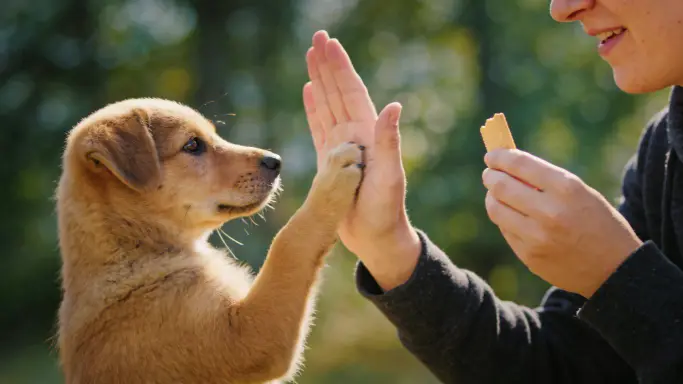
Basic commands are the foundation of puppy training. Learning these 3 commands can solve 80% of basic daily pet-raising problems and lay the groundwork for more complex training later. Beginners can start with these commands.
1. Command “Sit”: The Most Basic and Practical
“Sit” is the starting point of all commands. It helps puppies learn to calm down, avoid jumping on people or running around. The training steps are simple and easy for beginners to master.
Step 1: Prepare your puppy’s favorite treats (cut into small pieces to avoid overfeeding). Hold a treat above your puppy’s head, so it can see but not reach it.
Step 2: Slowly move the treat backward and upward. To reach the treat, your puppy will naturally sit down (this is an instinctive reaction).
Step 3: The moment your puppy sits down, immediately say the command “Sit”, give it the treat, and praise it in a gentle tone (such as “Good boy!” or “Well done!”).
Step 4: Repeat the above actions 3-4 times a day, 5 minutes each time. Gradually reduce the frequency of using treats until your puppy can sit down actively when it hears the command “Sit”.
2. Command “Come”: Key to Ensuring Your Puppy’s Safety
Whether in the yard, park, or if you accidentally let go of the leash, the command “Come” can quickly call your puppy back, preventing it from getting lost or eating dangerous things. It is a core command to ensure your puppy’s safety.
Step 1: Choose a quiet, distraction-free environment (such as your living room). Keep a distance of 1-2 meters from your puppy.
Step 2: Smile and call your puppy’s name in a gentle and attractive tone, then say the command “Come”.
Step 3: If your puppy takes the initiative to walk towards you, immediately reward it with a treat and praise. If it doesn’t move, gently clap your hands to attract its attention, or take a few steps back to arouse its interest in chasing. Reward it as long as it approaches you.
Step 4: Gradually increase the distance and environmental distractions (such as moving from the living room to the balcony, then to the community). Train repeatedly so that your puppy can immediately return to you when it hears “Come” in any situation.
3. Command “Stay”: Cultivate Your Puppy’s Impulse Control
“Stay” helps your puppy learn to control its impulses — such as not jumping on people when someone knocks at the door, not snatching food during meals, or not running around when meeting strangers. It will make your puppy a more well-behaved dog.
Step 1: Let your puppy sit first. Hold a treat in front of it, so it can smell but not get it.
Step 2: Say the command “Stay”. If your puppy stays still (even for 1-2 seconds), immediately give it the treat and praise it.
Step 3: Gradually extend the “Stay” time (from 1 second to 3 seconds, then 5 seconds), and slowly move the treat away. Continue until your puppy can stay still even when you are 1-2 meters away.
Step 4: Train in daily scenarios — for example, let it “Stay” before meals and say “Okay” to let it eat; let it “Stay” when opening the door and signal it to go out.
Practical Skill Training: Crate Training and Toilet Training
In addition to basic commands, crate training and toilet training are the most urgent skills for new owners to master — they can not only solve the trouble of “indoor accidents” but also prevent puppies from chewing furniture when left alone, making pet raising easier.
1. Crate Training: Make the Crate Your Puppy’s “Safe Haven”
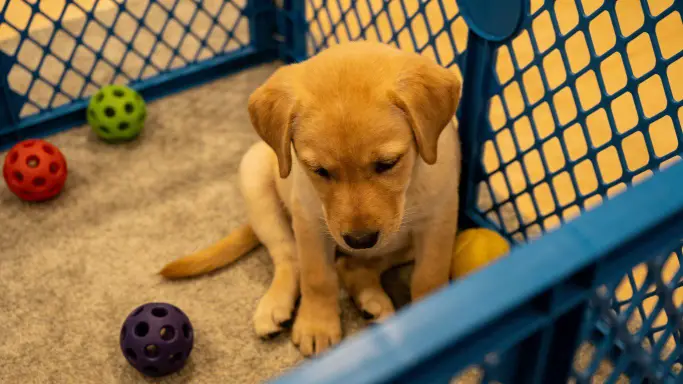
Many new owners mistakenly think that a crate is used to “punish” puppies, but this is not the case. For puppies, a crate should be a warm and safe “little home” where they can rest, sleep, and avoid external disturbances. It also helps owners manage their puppies better.
Training Methods:
Step 1: Arrange the crate — spread a soft towel or dog bed in the crate, put your puppy’s favorite toys and a few treats. Make the crate comfortable and attractive so your puppy is willing to approach it actively.
Step 2: Guide your puppy into the crate — hold a treat to guide it into the crate. When it enters the crate completely, immediately give it the treat and praise it. Then close the crate door gently (do not lock it) and open it after 1-2 minutes to let it come out.
Step 3: Gradually extend the time — repeat the guiding action every day, and slowly lengthen the time the crate door is closed (from 1-2 minutes to 5 minutes, then 10 minutes), so your puppy gradually gets used to being alone in the crate.
Notes: Never put your puppy in the crate to punish it for making mistakes; do not keep it in the crate for a long time (puppies need enough exercise every day); when the crate door is closed, ensure your puppy can breathe smoothly and there are no dangerous items around.
2. Toilet Training: Say Goodbye to “Urine and Feces Stains”
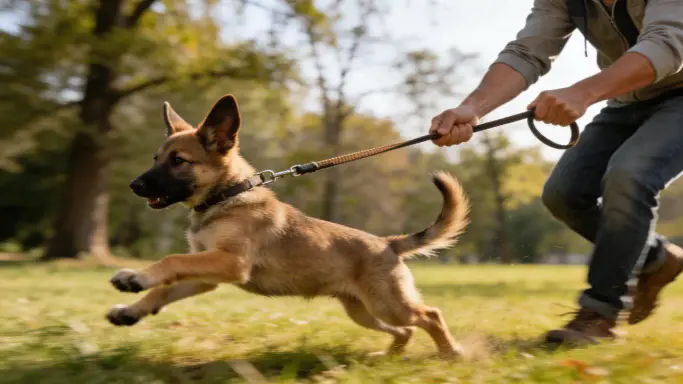
Puppies’ bladders and intestines are not yet fully developed, so they cannot control their bowel movements for a long time. Toilet training requires patience, but you can see obvious results in 1-2 weeks as long as you master the rules and methods.
Training Methods:
Step 1: Determine a fixed toilet area — choose a fixed place (such as your balcony or bathroom, covered with a grid mat or pee pad) as your puppy’s exclusive toilet area. Do not change it randomly.
Step 2: Grasp the toilet rules — puppies have obvious toilet habits, mainly concentrated in these times: after waking up, after eating, after drinking water, after playing, and before going to bed. During these times, take your puppy to the toilet area actively.
Step 3: Reward in time — if your puppy defecates smoothly in the toilet area, immediately reward it with a treat and praise it, so it understands “defecating here is correct”.
Step 4: Handle mistakes — if your puppy has an accident elsewhere indoors, do not scold or beat it (it will not understand what it did wrong). Immediately clean it with a pet-specific cleaner to remove odors (to avoid it defecating in the same place next time), then quietly take it to the toilet area to strengthen its memory of the area.
Tip: If you find your puppy circling, sniffing the ground, or whimpering softly, it means it is about to defecate. Hurry up and take it to the toilet area — the success rate will be higher.
Socialization Training: Help Your Puppy Integrate into Life Confidently
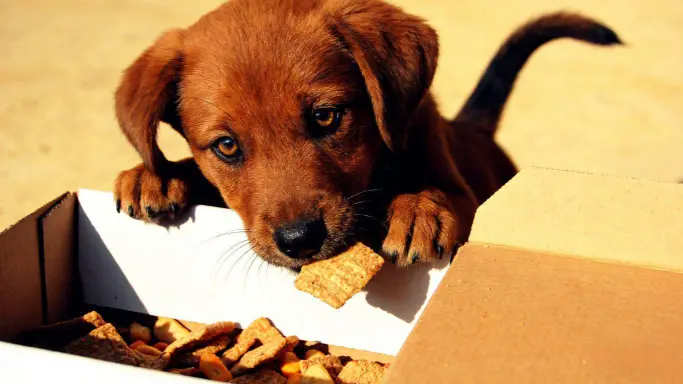
Many new owners ignore socialization training, leading to puppies becoming timid, afraid of people, afraid of other dogs, or even aggressive when they grow up. The core of socialization training is to let your puppy come into contact with different people, animals, sounds, and environments in a safe environment, cultivate its self-confidence and adaptability, so it can integrate into family and society calmly.
Key Methods of Socialization Training (Suitable for Beginners):
1. Human Contact: Let your puppy interact with all family members, as well as familiar relatives and friends (ensure these people like dogs and will not intimidate or tease your puppy). Let it get used to different people’s smells, voices, and touching methods.
2. Animal Contact: After your puppy completes its vaccinations, take it to contact other healthy and gentle dogs (such as neighbors’ dogs or friends’ dogs). Let it learn to get along with other dogs, master basic “dog etiquette”, and avoid fighting when meeting other dogs in the future.
3. Environmental Contact: Take your puppy for walks in different places (such as communities, parks, or supermarket entrances). Let it be exposed to different sounds (such as car horns, footsteps, and bird chirps) and different surfaces (such as floor tiles, grass, and slate roads) to reduce its fear of unfamiliar environments.
Notes: Socialization training should be gradual. Do not let your puppy come into contact with too many unfamiliar things at once to avoid scaring it. If your puppy shows timidity or withdrawal, do not force it — comfort it patiently and guide it slowly.
Training Mistakes: The Most Common Pitfalls for Beginners
Many new owners fail to train their puppies not because of wrong methods, but because they accidentally fall into training pitfalls. Be sure to avoid these 4 common pitfalls!
Mistake 1: Too Long Training Sessions. Puppies have short attention spans. If each training session exceeds 10 minutes, they will feel tired, impatient, and even resist training. The correct approach is to train 5-10 minutes each time, 3-5 times a day, using fragmented time for better results.
Mistake 2: Inconsistent Commands. If family members use different commands for the same action (for example, the owner says “Sit” while others say “Crouch”), the puppy will be confused and not know who to listen to, which will greatly reduce training efficiency. The correct approach is to use consistent commands throughout the family and do not change them randomly.
Mistake 3: Delayed Rewards. Puppies have short memories. Only by rewarding and praising them at the moment they perform the correct behavior can they connect “correct behavior” with “reward”. If you reward them a few minutes after they complete the action, they will no longer remember what they did right, and the training will be meaningless.
Mistake 4: Punishing Puppies for Mistakes. As mentioned earlier, puppies are not mentally mature. Punishment will only make them afraid of you, not make them understand their mistakes. On the contrary, it may lead to low self-esteem, aggression, and other problems. The correct approach is to ignore their wrong behaviors, focus on guiding them to perform correct behaviors, and then reward them.
Frequently Asked Questions (FAQ)
New owners always encounter various problems when training puppies. Below are the 5 most common questions with detailed answers to help you solve your doubts quickly.
Q1: What is the best age to start training a puppy? Can I still train it if I miss the best period?
The best age is 8-12 weeks old for easier training. If missed, you can still train your puppy with more patience to correct bad habits and develop good ones.
Q2: What treats are best for rewards during training?
Choose small, fragrant and easy-to-digest treats (e.g., professional training treats, freeze-dried food, small chicken pieces). Avoid salty/sugary human snacks and control the amount to prevent pickiness or obesity.
Q3: My puppy always chews furniture and shoes. How can I train it to stop?
Puppies chew due to teething or boredom. Offer teething toys to divert attention; gently stop them from chewing furniture/shoes, give a teething toy and reward them for using it.
Q4: My puppy keeps barking during crate training. What should I do?
Barking is normal at first (fear/dissatisfaction). Do not open the crate immediately; comfort them or give a toy. Open and reward only when they calm down to let them learn calmness leads to freedom.
Q5: I’ve been training my puppy for a long time, but it still doesn’t listen to commands. Am I too stupid?
No! Puppy training needs patience—learning speeds vary. Stick to correct methods, train repeatedly and reduce treats gradually, and your puppy will eventually understand. Training also strengthens your bond.